Stay ahead with the latest from Old Well Labs
Get product updates and insights delivered straight to your inbox.


This week we'll take a look at Columbia University’s endowment, which we last covered in November 2024.
Founded in 1754 as King's College, Columbia traces its first endowment funds to a £2,250 public lottery authorized in 1746. Today, the Columbia endowment stands at $17.9 billion as of 6/30/26, up from $15.9 billion a year earlier. The fund returned 18.3% in FY 2026 driven by equities, hedge funds, and venture capital, and has annualized 7.5% over five years and 9.9% over 10 years, lower than many of its Ivy League peers. OWL users can see full details on our Endowment Tracker.
The endowment is managed by Columbia Investment Management Company, a wholly owned subsidiary of the university. Kim Lew has led the organization since November 2020, succeeding Peter Holland, who retired after 17 years.
Lew arrived from the Andrew Carnegie Foundation (formerly Carnegie Corp), where she spent 13 years directing private equity investments before becoming CIO in 2016. Before that she spent more than a decade at the Ford Foundation handling technology and private equity investments. She holds degrees from Wharton and Harvard Business School.
Lew told Institutional Investor in a 2021 profile that she inherited a good portfolio with “some bets and biases,” and that she rebuilt the investment office’s infrastructure and aligned the team and board on objectives.
On the back of the endowment’s 2026 returns, she also told Chief Investment Officer that its hedge fund investments had strongly outperformed the benchmarks, and that while she and her team remain enthusiastic about private investments, they would continue to be selective due to valuations in the asset class.
The largest allocation shift under Lew’s tenure has been the growth of global equities within Columbia’s portfolio, which rose from 22% as of 6/30/20 to 35% as of 6/30/26:
The endowment’s exposure to absolute return strategies has fallen from 30% to 24% over the same timeframe, its exposure to real assets has fallen from 13% to 7%, and its exposure to private equity rose from 20% to 24%.
Disclosures for endowments vary and Columbia only discloses a handful of its manager investments. Below is a select group of Columbia’s public and private manager holdings as of 6/30/25:
Columbia disclosed three investment managers for the first time in FY 2025 – Numerai, Pantera, and 5th Century. Numerai, founded in 2015 by Richard Craib, is a quant hedge fund that runs a data science tournament every year using anonymized financial data where players stake their models with Numerai’s own cryptocurrency, and the manager takes the best performing models and uses them to inform parts of its own trading algorithms.
Based in Tokyo, Strategic Capital was founded in 2012 by Tsuyoshi Maruki, a veteran of Japan's first activist wave. Maruki spent 17 years at Nomura Securities before helping launch M&A Consulting (MAC), the activist fund led by Yoshiaki Murakami, in 1999. After Murakami's 2006 insider trading arrest, Maruki oversaw the return of investor capital as the fund, then around ¥500 billion, closed in 2007.
Columbia first disclosed an $82 million investment in Strategic in 2021, now worth $206 million as of 6/30/25.
Over the past five years, Strategic’s disclosed holdings have outperformed the TOPIX by an estimated 100% and the firm now manages roughly $975M.
Strategic takes influential minority stakes in undervalued, governance-challenged Japanese small and mid-caps, and describes its approach as more confrontational than most Tokyo-based managers.
In an article in July, Forbes counted Strategic among its grouping of the “new activists” in Japan’s public markets. The article describes that attitudes toward activism in Japan are softening, as Tokyo Stock Exchange guidance on cost of capital and rising financing costs push companies to justify idle cash, cross-shareholdings, and underperforming assets, which are the targets the article says Strategic pursues.
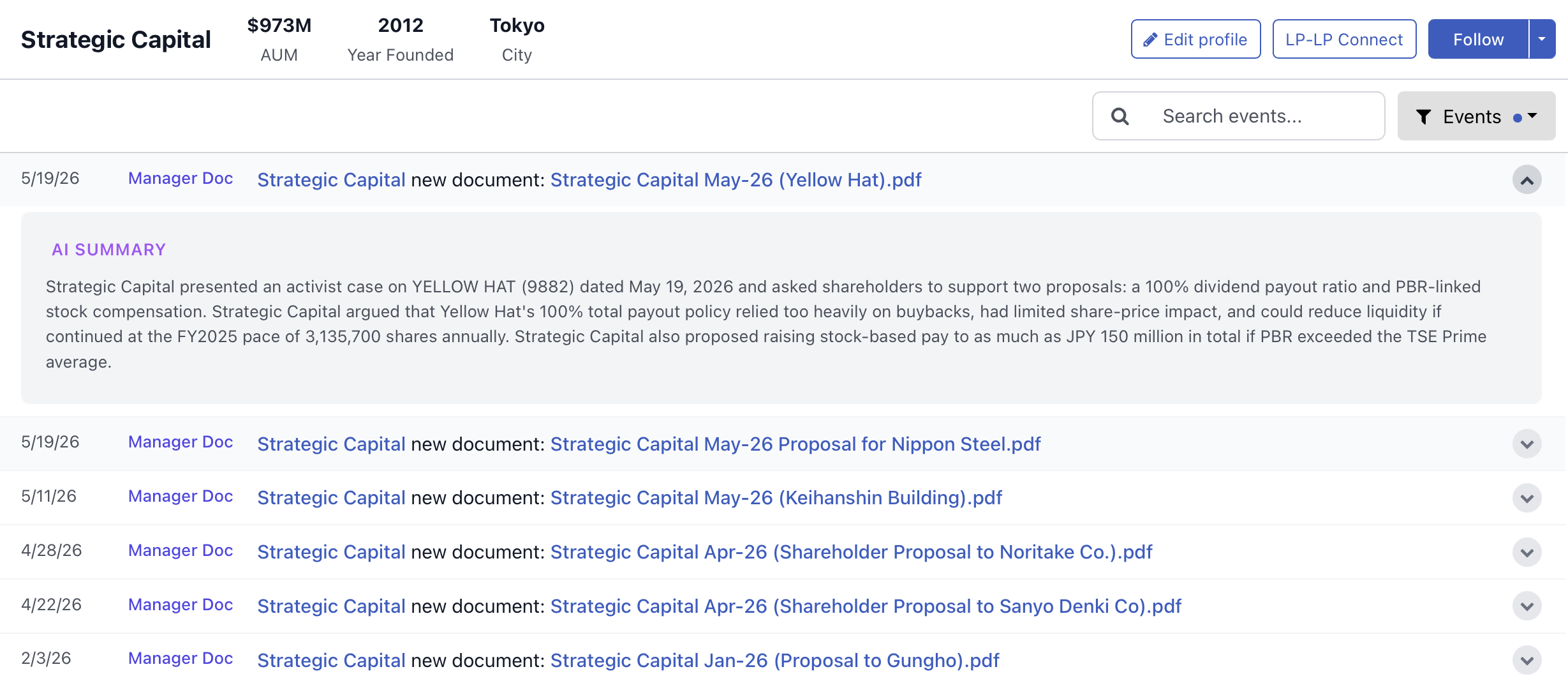
Many of Strategic’s shareholder and activist campaign decks are available on OWL and give examples of proposals it has made to companies this year including Nippon Steel, Yellow Hat, and Sanyo Denki.
OWL is the best place to track activist campaigns for Japan managers – we collect campaign docs and provide AI summaries of them to easily see each manager’s plan for its activist campaigns.
Strategic currently discloses 11 positions, all based in Japan, and covering financials, basic materials, industrials, consumer cyclicals, technology, and consumer non-cyclicals.
Using OWL’s new Contribution tab, users can see that over the past five years two of Strategic’s current holdings have been among its top contributors to its performance, and three of its current holdings have also been among its top detractors:

This newsletter and the material on the Old Well Labs platform are for informational purposes only and should not be considered investment advice or a recommendation of any particular security, manager, or strategy. Certain investment managers, funds, or limited partners (“LPs”) referenced herein may be current or prospective clients of Old Well Labs, and Old Well Labs may have business relationships with such parties. Accordingly, references to any manager, fund, or LP should not be construed as an endorsement, recommendation, or solicitation. Old Well Labs shall not be liable for any investment gain or loss that may occur from the use of this material. No part of this material may be reproduced in any form or used in any publication without express written permission from Old Well Labs.