Stay ahead with the latest from Old Well Labs
Get product updates and insights delivered straight to your inbox.


This week we’ll take a look at the disclosed portfolio of Bowdoin College. Founded in 1794 with a $1,000 gift from philanthropist and statesman James Bowdoin III, the endowment has grown to oversee approximately $2.9 billion as of 6/30/25.
Over the past three decades, Bowdoin’s endowment has seen rapid growth beginning with the appointment of Paula Volent as CIO in 2001 when the endowment managed around $465 million. Volent, a disciple of the Yale endowment’s David Swensen, grew Bowdoin to roughly $2.7 billion in AUM over her 20 year career. Volent’s path to Bowdoin was an unconventional one – she has degrees in Chemistry and Art History and worked for major art institutions before pursuing an MBA at Yale. While there, she interned in the investment office. She noted in an HBS case study that “It was a new and mysterious world to me, but I fell in love with finance and endowment management.”
While at Bowdoin, she worked closely with Duquesne Capital founder Stan Druckenmiller, who chaired the university’s investment committee at the time.
After she stepped down to join the Rockefeller University endowment in 2021, Volent was succeeded by K. Niles Bryant. Bryant had joined the Bowdoin endowment as director of investments in 2020 after serving in similar roles at the Gordon and Betty Moore Foundation and the Carnegie Corporation. Under Bryant, the Bowdoin endowment saw its assets drop briefly coming out of the pandemic before reversing to reach its current total of nearly $3 billion.
In late 2025 Bryant announced he would be stepping down to join Sutton Place Limited, a large single-family office that some reports have linked to the Getty family. After a national search, Bowdoin promoted former director of investments Boris Raykin to CIO in July.
Over Volent’s tenure, the allocation to private equity (which includes venture capital) increased from 10-15% to 30-35%. As Druckenmiller noted in the 2021 HBS case study:
“The relative growth in the portfolio of private equity and, in particular, venture is mostly performance. It wasn't a decision to allocate big in this area but rather that Volent had the right performers, both established and new, and we have let those great horses run. But that doesn't mean we do not watch closely the implications for liquidity of these investments and their unfunded commitments. We will not let those positions run beyond what we think is a comfortable level of liquidity and margin to operate should market conditions change. We learned a lesson from what some of the large endowments went through during the market crash of '08, when they found themselves with heavy allocations to privates and large unfunded commitments. This is always an area of active discussion for us.”
As of 6/30/25, private equity comprised 37% of the portfolio:
Bowdoin has generated strong returns, ranking first among the over 1,000 endowments that OWL tracks over 5 years and third over the past 10 years.
Bowdoin only disclosed a few managers by name in its most recent public filings, including Verso Partners and BeaconLight.
Based in San Francisco, Verso Partners was founded in 2021 by Mike Siliciano and Josh Sweren. The pair began their careers together as analysts at Cardinal (CPMG). Siliciano left in 2011 to join Taconic Capital, later rejoining Cardinal and working his way up to partner, while Sweren departed around the same time for Farallon, where he spent nearly a decade, most recently serving as a managing director.
Verso employs a long/short equity strategy with a particular focus on the short side, influenced by the founders’ time at CPMG, one of the best-known short sellers backed by many large endowments and foundations over the past 20+ years. Verso runs three separate vehicles - Verso Investment Partners, its primary fund, Verso Enduring Growth, and Verso Opportunities Fund, which was renamed to Verso Alpha Driven Returns Fund in 2025. In its most recent tax filing, Bowdoin disclosed a $26.9 million holding in the Alpha Driven Returns fund. The endowment first disclosed an investment in Verso in 2022 with a $16.8 million holding in the then-named Opportunities Fund.
OWL users can see additional information, including Verso’s disclosed investment from an Ivy League endowment, here.
Based in New York, BeaconLight Capital was founded in 2009 by Ed Bosek. Bosek had originally planned on entering the medical industry as a doctor, attending UPenn on the university’s pre-med track, but through friends in the Wharton business school developed an interest in finance and earned his MBA instead.
After graduation Bosek joined Deutsche Bank as an intern and, after initially accepting a full time offer, pivoted to the hedge fund industry and joined Atticus Capital on its European team instead.
Finding it “harder to generate strong returns for large portfolio sizes” as Atticus grew, Bosek reportedly launched BeaconLight with $50 million in funds to focus on his “FMD” approach, defined as “fundamental, meaningful, and different.”
Today, BeaconLight manages a regulatory AUM of approximately $445 million and employs a global fundamental long/short equity strategy focused on developed markets. The manager’s strategy has outperformed relevant benchmarks by a significant margin over the past 10 years, according to OWL’s estimated performance based on disclosed long positions:
Bowdoin first disclosed a holding with BeaconLight in its latest tax filing, showing a $4.9 million holding in the manager’s Opportunities Fund as of 6/30/25.
Cantillon Capital, the global public equity investor founded in 2003 by former Lazard director William von Mueffling, terminated its SEC registration as of August 20th, which OWL users would have seen in their feed:

Cantillon’s regulatory AUM sat at roughly $22.8 billion as of March of this year.
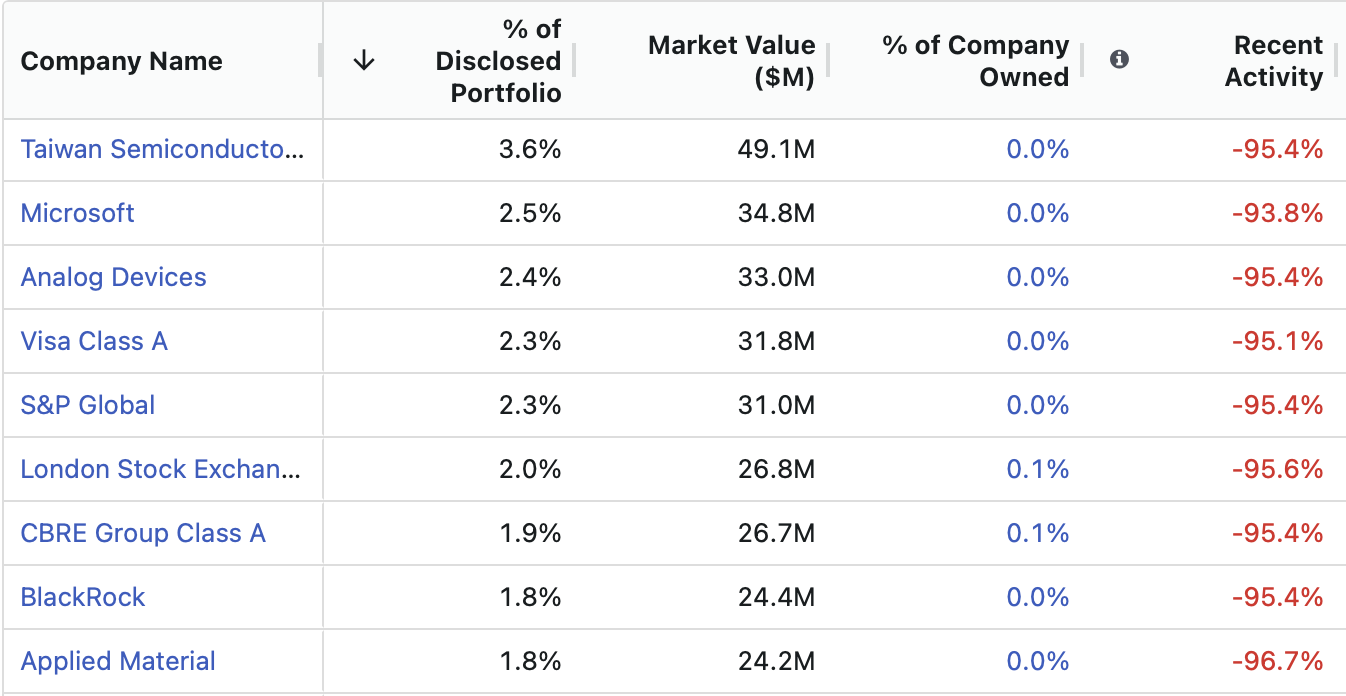
The firm’s Q2 13F included $665 million in holdings vs. $15 billion disclosed in Q1. OWL users can see the meaningful decline on Cantillon’s positions page:
This newsletter and the material on the Old Well Labs platform are for informational purposes only and should not be considered investment advice or a recommendation of any particular security, manager, or strategy. Certain investment managers, funds, or limited partners (“LPs”) referenced herein may be current or prospective clients of Old Well Labs, and Old Well Labs may have business relationships with such parties. Accordingly, references to any manager, fund, or LP should not be construed as an endorsement, recommendation, or solicitation. Old Well Labs shall not be liable for any investment gain or loss that may occur from the use of this material. No part of this material may be reproduced in any form or used in any publication without express written permission from Old Well Labs.